Showing posts with label Home Brew Recipe. Show all posts

Sunday, February 28, 2016

5 Beginner Tips for Beer Recipe Formulation

www.brew-boss.com Brew Boss Electric Homebrew Equipment


The art and science of formulating a beer recipe from scratch is an involved process. While we aren’t going to walk through all the steps since they could fill a book (in fact they do: Designing Great Beers), here are five tips to consider for those testing the waters of custom recipe formulation.

1. Find Inspiration

Without an end goal in mind, there is the risk of creating a kitchen-sink beer—and not one of those tasty ones, but the kind that is muddled and unfocused. Determine the inspiration behind your recipe and form a goal and stick with it.

Inspiration could come in the form of a classic style, interesting ingredient or your favorite commercial brew. Whatever it is, try to keep the goal at the front of your mind as you formulate the recipe. Your inspiration will factor greatly in decision making, especially if you establish targets for specifications like the original gravity, color, bitterness, etc.

2. Limit Ingredients

With a goal in mind, make a list of all the possible ingredients that could be used in your beer. This includes grains, hops, yeast, adjuncts and even different water types. You can use other recipes, BJCP style guidelines or brewing books to learn about typical ingredients for specific styles.

Take the time to dig into each ingredient a bit to know what it will contribute to the profile of the beer. If it sounds like something you’d want, write it down. Last, slim down your ingredient list to the bare essentials—the least amount of ingredients needed to achieve your goal. The old saying “less is more” can go a long way in making a great recipe. 

3. Tailor Recipe to Your System

Knowing your system and being able to anticipate its variables is invaluable when planning a beer recipe. Establish your limitations based on your equipment and process. Are you able to do full boils? If not, this will effect the quantity of your hop additions. Can you hold fermentation temperatures near freezing? If so, you can have a go at a lager recipe.

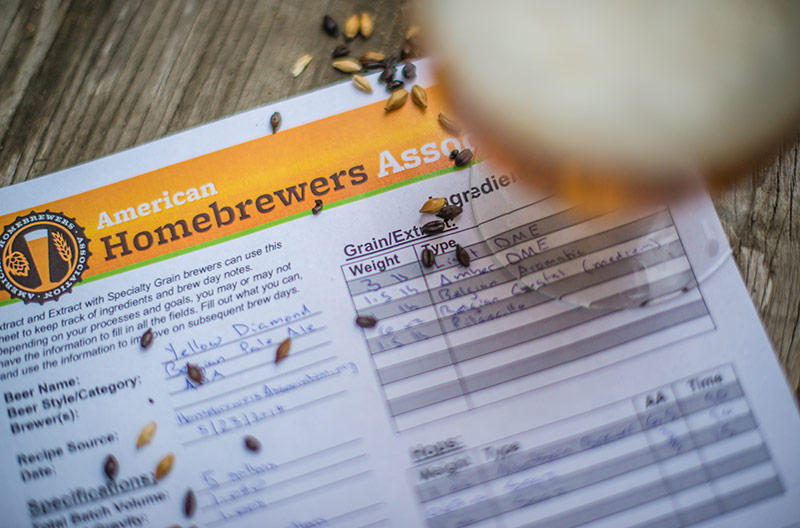
Homebrewers should also take detailed notes of their brew days, which can be referenced in the future in order to better predict the outcome of a beer. Use our homebrewing notes sheets to keep track of all your brew day specs on one convenient page. It’s much easier than trying to remember the finer details a few months down the line.

4. Consider Various Techniques

The beauty of homebrewing is the various techniques that can be adopted to fit your process and goals. If you are looking for a dry finish, you could try a highly attenuative yeast, adding simple sugars to the boil or mashing at lower temperatures. All of these will result in a similar effect, but through different means and typically under different circumstances. Consider things like pitching rates, mash steps and fermentation schedules, which can vary widely depending on your end goal.

5. Repeat

It’s understandable to want to try a new recipe every time you brew, but one of the best ways to hone in a recipe is to brew it over and over again, making minor tweaks in hopes of improvement. Bring your brew to homebrew club meetings or submit it into competitions to see how it is received. Take into consideration all feedback, and see how it may influence changes to the recipe. You can’t improve a recipe if you never try to make it again…rarely does it come out as perfect as you imagined the first time around!

Sources: Designing Great Beers by Ray Daniels; Brad Smith’s “Beer Recipe Design” seminar at the 2013 National Homebrewers Conference (conference seminarsavailable to members)

Wednesday, February 24, 2016

Lagunitas Little Sumpin’ Sumpin’ Clone

#brewboss #homebrew Brew Boss Electric Homebrew Equipment www.brew-boss.com
lagunitas little sumpin

Jami Zainasheff, author, Brewing Network host, and professional brewer at Heretic Brewing Co., doesn’t buy the notion that the equipment homebrewers use versus the equipment professionals use makes a significant difference. He believes the only real difference is controlling fermentation. So when Amahl Turczyn made a clone of Lagunitas Little Sumpin’ Sumpin’, he was sure to keep Jamil’s wise words in mind.

Lagunitas’ Little Sumpin Sumpin is nothing short of delicious. It’s a truly a unique style that features a strong hop finish like an IPA but boasts nearly 50% wheat grain bill, giving this beer some smooth hefeweizen characteristics. All the hops starting with the letter “C” are used in this beer, but the bitterness still remains low enough not to wreck your palate.

It pours bright orange to copper in color, with grapefruit and orange aromas tingling your nose. After your first sip, you’ll experience some citrusy hops along with earthy hops before it smooths out in a creamy and slightly bitter finish. If you don’t like extremely hoppy beers, this recipe’s for you. So, after your beer’s finished, put your feet up and ask your loved-one to grab a Little Sumpin’ Sumpin’ from the fridge. Just make sure you say “please.”

Lagunitas Little Sumpin’ Sumpin’ Clone | American Pale Ale

INGREDIENTS

  • For 5.5 Gallons (20.82 L)
    • 7.0 lb (3.18 kg) two-row pale malt
    • 5.0 lb (2.27 kg) white wheat malt
    • 1.75 lb (0.79 kg) torrified wheat
    • 1.0 lb (0.45 kg) rice hulls (in mash, optional)
    • 3.0 oz (85 g) caramel wheat malt
    • 0.75 oz (21 g) Nugget, 13% a.a. (60 min)
    • 0.25 oz (7 g) Willamette, 5.5% a.a. (30 min)
    • 0.25 oz (7 g) Willamette, 5.5% a.a. (15 min)
    • 1.0 oz (28 g) Santiam, 6% a.a. (15 min)
    • 0.75 oz (21 g) Amarillo, 8.5% a.a. (dry hop 5 days)
    • 0.75 oz (21 g) Cascade, 5.5% a.a. (dry hop 5 days)
    • 0.75 oz (21 g) Centennial, 10% a.a. (dry hop 5 days)
    • 0.75 oz (21 g) Chinook, 13% a.a. (dry hop 5 days)
    • 0.75 oz (21 g) CTZ, 14% a.a. (dry hop 5 days)
    • Whirlfloc tablet (15 min)
    • White Labs WLP007 Dry English ale yeast

    SPECIFICATIONS

    • Original Gravity: 1.071
    • Final Gravity: 1.015
    • ABV: 7.5%
    • IBU: 40
    • SRM: 5

    DIRECTIONS

    To brew this Little Sumpin’ Sumpin’ clone, use 1 gram-per-gallon to treat distilled or RO water. Mash with rice hulls to aid with lautering if desired. Use a single infusion mash at 150°F (66°C), no mash out. Do a 90 minute boil and follow hop schedule.
    Primary fermentation at 67°F (19°C). Dry hop five days in primary.
    Filter if you have the means, fine with gelatin in secondary if you don’t.
    Drink as fresh as possible (~2-3 weeks after packaging) for maximum dry hop character.

    Extract Option

    Substitute 3.9 lb (1.77 kg) pale malt extract syrup for the two-row pale and 7 lb wheat malt extract syrup for the wheat malt, torrified wheat and caramel wheat. Note that extract recipe will be slightly darker (9 SRM) than all-grain version.
    http://www.homebrewersassociation.org/homebrew-recipe/lagunitas-little-sumpin-sumpin-clone/

    Monday, February 22, 2016

    Brewing with Specialty Grains

    #homebrew #brewboss Brew Boss Electric Homebrew Systems www.brew-boss.com


    You may want to try your hand at #brewing #recipes that also utilize specialty grains. This involves soaking malt that does not require mashing in your boil water prior to adding the malt extract.

    Why Brew Extract Recipes with Specialty Grains? 
    Tasty beer can be made exclusively with extract, but there can be issues with the freshness of ingredients. Liquid and dry malt extracts have less noticeable affects from aging than fresh ingredients, so it is possible to brew a beer entirely with extract, conduct your process perfectly, but still come out with an off-tasting product. Utilizing specialty grains will allow for more combinations of flavors and aromas, while taking some of the spotlight off of the extract. Brewing with specialty grains is also a great way for new brewers to become familiar with fresh ingredients and develop an understanding of which grains instill which qualities to certain styles of beer.

    Am I Mashing Yet? 
    Though sometimes confused, utilizing specialty grains is not the same as mashing. The concepts are similar—soak crushed malt in a specific amount of water, at a specific temperature, for a specific amount of time—but the biological processes differ, which cannot necessarily be seen with the naked eye. In short terms, the point of mashing is to create the right conditions for enzymes to convert grain starches into fermentable sugars. Specialty malts, like caramel and roasted malts, do not require a mashing step because their starches have been converted to sugars by heat when kilned. On the other hand, if you do not mash base malt, like pale or maris otter, the starches will not be converted to sugars and the yeast will have little to nothing to convert into CO2 and alcohol.

    Walk Me Through It Already! 
    Brewing with specialty grains only requires one additional step to the extract process that is covered in the beginner section. Essentially, you are steeping the specialty grains in 150° to 170° F (65.5°- 76.7° C) water for about 30 minutes prior to adding the malt extract. Most brewers use a grain bag to contain the specialty malt while steeping, much like a large tea bag. This makes it easier to remove the grains from the kettle when the steeping is done. As a tutorial, we will be using a recipe and set of procedures from Chapter 13 of John

    Palmer’s How To Brew.

    Port O’Palmer Porter 

    Ingredients for 5 U.S. gallons (18.92 L):

    • 6.6 lb (3 kg) | Pale malt extract (liquid) 
    • 0.5 lb (227 g) | Crystal 60°L malt
    • 0.5 lb (227 g) | Chocolate malt  0.25 (113 g) | Black Patent malt 
    • 0.5 oz (14 g) | Horizon hops (12% Alpha Acid) (60 minutes) 
    • 0.75 oz (21 g) | Willamette hops (5% Alpha Acid) (40 minutes) 
    • 0.5 oz (14 g) | Willamette hops (5% Alpha Acid) (20 minutes) 
    • London Ale liquid yeast 


    Specifications: Boil Gravity for 3 gallons: 1.047 (13.3 °P) OG for 5 gallons: 1.054 (11.7 °P) IBUs: 38

    Fermentation: Primary for 2 weeks at 65° F (18° C)

    Procedure:
    1. The only change from your regular extract brewing procedure is that you will be steeping the grain in the brew pot before you add the malt extract. For the best flavor results, the ratio of steeping water to grain should be less than 1 gallon per pound.
    2. Heat 1 gallon of water in the brew pot until it reaches 160° F (71.1°C) give or take 10° F (5.5°C)
    3. Immerse the grain bag in the pot for 30 minutes. The grain bag may be dunked and swirled like a teabag during this time to make sure all the grain is wetted. Moving it around will help to improve the yield, but don’t splash. Maintaining temperature during the steep is not vital.
    4. After 30 minutes, remove the grain bag from the pot, and let it drain to avoid dripping on the stove.
    5. Now you have a preliminary wort to which the malt extract is added. Stir in one can (3.3 lbs., 1.5 kg) of pale malt extract. Add more water to the pot to bring the wort volume up to 3 gallons (11.4 liters)
    6. Bring the wort to a boil, add hop additions as listed in the recipe.
    7. When the wort is finished boiling, add the remaining can of pale malt extract to the brew pot. Stir it in to make sure it is fully dissolved. After 10 minutes total time has elapsed, the additional extract is pasteurized, and you can proceed to cooling the wort, pouring it into the fermenter, pitching the yeast, etc.

    https://www.homebrewersassociation.org/wp-content/uploads/How-To-Specialty-Grains.pdf

    Wednesday, January 13, 2016

    Hopped up IPA

    India Pale Ale
    All Grain

    Brewer/Contributor: Don Pfeiffer
    Batch Size: 5.50 gal
    Boil Size: 7.00 gal

    Hopped up IPA
    Type: All GrainDate: 8/19/2004
    Batch Size: 5.50 galBrewer: Don Pfeiffer
    Boil Size: 7.00 galAsst Brewer:
    Boil Time: 60 minEquipment: Shakey Dog Brewery
    Taste Rating(out of 50): 35.0Brewhouse Efficiency: 70.00
    Taste Notes:
     
    Ingredients
    AmountItemType% or IBU
    9.00 lbPale Malt (2 Row) US (2.0 SRM)Grain64.29 %
    2.00 lbCaramel/Crystal Malt - 20L (20.0 SRM)Grain14.29 %
    2.00 lbWhite Wheat Malt (2.4 SRM)Grain14.29 %
    1.00 lbVictory Malt (25.0 SRM)Grain7.14 %
    0.50 ozChinook [13.00 %] (60 min)Hops19.8 IBU
    1.00 ozCascade [5.50 %] (45 min)Hops15.4 IBU
    1.00 ozCascade [5.50 %] (30 min)Hops12.9 IBU
    1.00 ozCascade [5.50 %] (15 min)Hops8.3 IBU
    1.00 ozCascade [5.50 %] (5 min)Hops3.3 IBU
    1.00 ozCascade [5.50 %] (Dry Hop 7 days)Hops-
    1 PkgsCalifornia Ale (White Labs #WLP001)Yeast-Ale
     
    Beer Profile
    Est Original Gravity: 1.065 SGMeasured Original Gravity: 1.065 SG
    Est Final Gravity: 1.014 SGMeasured Final Gravity: 1.010 SG
    Estimated Alcohol by Vol: 6.56 %Actual Alcohol by Vol: 7.18 %
    Bitterness: 59.6 IBUCalories: 290 cal/pint
    Est Color: 10.0 SRMColor:
    Color
     
    Mash Profile
    Mash Name: Single Infusion, Medium Body, No Mash OutTotal Grain Weight: 14.00 lb
    Sparge Water: 4.56 galGrain Temperature: 72.0 F
    Sparge Temperature: 168.0 FTunTemperature: 72.0 F
    Adjust Temp for Equipment: TRUEMash PH: 5.4 PH
     
    Single Infusion, Medium Body, No Mash Out
    Step TimeNameDescriptionStep Temp
    60 minMash InAdd 17.50 qt of water at 165.9 F154.0 F
     
    Mash Notes: Simple single infusion mash for use with most modern well modified grains (about 95% of the time).
    Carbonation and Storage
    Carbonation Type: Corn SugarVolumes of CO2: 2.4
    Pressure/Weight: 4.2 ozCarbonation Used: -
    Keg/Bottling Temperature: 60.0 FAge for: 28.0 days
    Storage Temperature: 52.0 F

    http://beersmith.com/Recipes2/recipe_242.htm


    Tuesday, December 29, 2015

    Recipe: Grimm Brothers Brewhouse Snowdrop (Kottbusser)

    Kottbusser is a German beer style that was outlawed in 1877 due to the German Beer Purification Law, which restricted beer ingredients to just barley, hops, water and (once discovered) yeast. The golden-hued ale uses wheat, oats and barley for the grist, a dose of noble hops to add floral notes and honey and molasses for more fermentable sugars and a hint of subtle complexity. Unlike more well-known styles of German wheat beers, like hefeweizen, kottbusser is fermented with a clean ale yeast, leaving little to not yeast character in the finished beer.
    Grimm Brothers Brewhouse of Loveland, Colorado shared the recipe for their kottbusser ale, Snowdrop. Snowdrop earned a bronze medal in the 2015 Great American Beer Festival. To learn more about kottbusser and to get some tips on brewing the style from Grimm Brothers, check out 6 Tips on Brewing Kottbusser from Grimm Brothers Brewhouse

    Grimm Brothers Brewhouse Snowdrop (Kottbusser) | Specialty Beer

    INGREDIENTS

  • For 5 gallons (18.9 L)
    • 6.0 lbs (2.7 kg) Pilsen malt
    • 3.0 lbs (1.4 kg) Wheat malt
    • 0.7 lbs (0.3 kg) Flaked Oats
    • 0.04 lbs (18 g) Molasses
    • 0.08 lbs (36 g) Honey
    • 0.05 oz (1.4 g) Hallertau hops (FWH)
    • 0.25 oz (7 g) Magnum hops (75 minutes)
    • 0.25 oz (7 g) Hallertau hops (30 minutes)
    • 0.5 oz (14 g) Hallertau hops (0 minutes)
    • 1 oz (28 g) Saaz hops (0 minutes)
    • White Labs German Ale/Kolsch Yeast (WLP029)

    SPECIFICATIONS

    • ABV: ~7%
    • Boil Time: 90 minutes

    DIRECTIONS

    To brew this Kottbusser, mash grains at 152°F (67°C) for 60 minutes. Sparge at 168°F (76°C).
    Conduct a 90 minute boil.
    Ferment at 63°F (17°C).

    Friday, November 6, 2015

    5 Tips on Brewing IPAs from Mitch Steele

    Brew Boss Electric Home Brew Equipment www.brew-boss.com


    Judging by the trends the American Homebrewers Association has seen, the India pale ale still reigns supreme as a favorite style of both homebrewers and craft beer enthusiasts.

    IPAs occupied the top five places in Zymurgy‘s Best Beers in America survey, with Russian River’s Pliny the Elder claiming the number one spot for the fifth consecutive year, and half of the top fifty were some form of the style.

    Mitch’s Tips for a Great IPA

    In celebration of IPA Day (#IPAday) we asked Stone Brewing Co. Brewmaster Mitch Steele to offer some tips on homebrewing great India pale ales.

    Steele has been brewing at commercial facilities, large and small, for the last 25 years, and he has always had an obsession with hoppy IPAs (visit his blog, The Hop Tripper). This obsession culminated in Steele’s recent book IPA: Brewing Techniques, Recipes and the Evaluation of India Pale Ale.

    In addition to forty-eight IPA recipes ranging from historical beers to popular commercial clones, Steele’s book covers everything you need to understand the celebrated style inside and out.

    Here are five tips from Mitch Steele, which might help your IPA competition entries rise to the top…or at the very least you’ll end up with tasty IPA to share!
    1. Keep the crystal malts to a minimum (5% or less). Use Munich malt or some other lightly-roasted malt if you want more color.
    2. British pale ale malt (Golden Promise or Maris Otter) is excellent for using in all versions of IPA.
    3. Don’t forget about older “classic” hop varieties. Everyone wants to use Amarillo, Mosaic and Citra right now, and understandably so. These are exciting new varieties that provide unique flavors, but some of the best IPAs I’ve had recently were dry-hopped with Cascade or Sterling.
    4. Similarly, don’t be afraid to use hops that aren’t considered “IPA hops.” There are some great, highly aromatic hops available from Germany and England, for example, that add wonderful nuances to an IPA.
    5. Brew your beer to be reasonably dry. This means using lower mash temperatures (148-152°F) to make highly fermentable wort. This is especially important in double IPAs because higher alcohol adds a perception of body and sweetness to a beer, and you don’t need to add to that by having a lot of unfermentable dextrins. Drier beers allow the hops to shine.

    Bombay Bomber IPA

    The following is a recipe from IPA: Brewing Techniques, Recipes and the Evolution of IPA. This recipe is formatted so it can be used for a batch of any size. Grain percentages, original gravity and hop additions along with target IBUs should be enough information for homebrewers to deduce a recipe fit for their target batch volume and system.

    When Steelhead Brewing Company opened on January 22, 1991, Bombay Bomber IPA was on draft as the seasonal offering. The IPA was such a hit that Steelhead never took it off tap, making Bombay Bomber one of the first IPAs to be continually served as a flagship offering at a U.S. brewpub.

    Teri Fahrendorf, former Steelhead brewer, developed Bombay Bomber and describes it as a “party in your mouth.” More specifically, the brewpub menu stated: “Deep gold. Citrus-floral hop aroma with lots of malt flavors, leading to an intense hop finish.”

    Ingredients
    Western (American) two-row malt (71%)
    American Munich malt 10°L (22%)
    American Vienna malt 4°L (7%)
    Chinook hops (90 minutes)
    Crystal hops (20 minutes)
    Chinook hops (0 minutes)
    Crystal hops (0 minutes)
    Chinook (dry)

    Specifications
    Original Gravity: 14.2 °P (1.057 SG)
    Final Gravity: 3.2 °P (1.013 SG)
    ADF: 77.5%
    IBU: 57
    ABV: 6%

    Directions

    The recipe traditionally uses Eugene, Oregon mountain run off (soft) water with added gypsum.

    Employ a single-step conversion mash at 153°F (67°C) for 1 hour.

    Follow the 90 minute boil schedule as noted in the ingredients. Fast chill and transfer to a fermenter in 10 minutes (this is what saves the aroma!).

    Ferment at 67°F (19°C) for 18 days with the yeast of your choosing. On the third day, dry hop with Chinook at bunging. Beginning on day four, make sure to keep top pressure on the beer to naturally carbonate. Pull the yeast on day 10. Chill to 32°F (0°C) for the final three days (days 19-21), and filter for a bright, crisp taste.

    https://www.homebrewersassociation.org/how-to-brew/5-tips-on-brewing-ipas-from-mitch-steele/

    Friday, October 23, 2015

    HOMEBREWING THE STONE 09.09.09 VERTICAL EPIC ALE

    HOMEBREWING THE STONE 09.09.09 VERTICAL EPIC ALE


    The idea of brewing a Belgian Imperial Porter was something that we had discussed a few times in the past few years, especially after taste panel sessions that had included Belgian Imperial Stouts and Belgian Black beers. Roasted malts and the spicy, fruity flavors from Belgian yeast strains combine surprisingly well, provided proper balance is maintained in the recipe. And we thought an Imperial Porter, with an intense chocolate malt character, might be a fun, and a bit different, version of a Belgian dark ale to try.

    With the Stone 09.09.09 Vertical Epic Ale, we were also able to incorporate some ingredients and techniques that we had been exploring a bit with our pilot system and small batch special creation program, such as the use of vanilla beans, tangerine peel, and the French oak chip aging process.
    The vanilla bean (used at a lower addition rate than what we use in the Stone Smoked Porter with Vanilla Bean) complements and actually enhances the chocolate flavors from the chocolate malt, and likewise, the French oak enhances the sensation of vanilla. Combined together with the other ingredients, the result is a multifaceted, delicious beer with several layers of depth and flavor.
    We hope you enjoy our latest beer (our 8th in the Vertical Epic series), and have as much fun brewing it as we did.


    Here is the grain bill:

    Pale Malt                                 73.1%
    75-80°L Crystal Malt              10.4%
    Chocolate Malt                       5.4%
    Belgian Aromatic Malt           4.3%
    Dark Candi Sugar                   3.4% (added to boil)
    Black Malt                              1.7%
    Carafa Malt                             1.7%

    Again, I am only providing the all grain version of the recipe. I’ve never brewed with extracts, so I’m not the best person to attempt to convert this recipe to an extract one. If someone wants that information, I’d recommend consulting a local homebrew shop or a homebrewing web site or forum to get help in making the conversion.
    The goal with this grain bill was to make a complex porter, but without so much dark malt that the yeast and spice flavors would get overwhelmed. In addition, we wanted the chocolate malt to be the dominant dark malt flavor, so we only used a low percentage of black malt, and added small amounts of dark candi sugar and Carafa malt to get some color and flavor complexity without overwhelming the chocolate notes.
    Target OG: 20°P (1.080 SG).


    Mashing:
    Use a 45 minute conversion rest at 150°F. This helps provide a fairly fermentable wort. Lower temperatures and a longer conversion time rests help accentuate dryness of beer. With almost 15% crystal and aromatic malt, a conversion temperature in the normal porter range of 153-156°F might have made this beer too sweet.
    If you can, raise your mash temperature up to 165°F to stop the enzymatic conversion of starches to sugars before lautering. If you cannot do that, cut your conversion rest to 20-30 minutes.

    Lautering:
    Recirculate your wort gently from the bottom over the top of the mash to deposit the fine particles of malt on the top of the grain and to “set” your bed. Avoid splashing the wort. The wort will be too dark to check clarity easily, so recirculate for 5-15 minutes, depending on your system, before diverting wort flow to your kettle/boiling vessel. If you have a refractometer, check your “first wort” (unsparged wort) gravity, it should be about 22-23°P (1.088-1.092 SG).
    Start sparging in the lauter when the wort level is about ½” above the grain bed. Starting earlier will decrease your efficiency, because the water will dilute your first wort. Sparge water should be between 165°F and 170°F to maximize extraction, but avoid going over 170°F or you’ll extract harsh compounds from the malt husks.
    Sparge until you hit your target boil volume or until your wort gravity being drawn-off reaches 3°P (1.012 SG), whichever comes first. Don’t lauter past 3°P, because when the sparged wort coming off the lauter is that low in sugar content, you risk extracting tannins and other harsh character from the malt husks.

    Boil:

    Here is the hop bill:
                4.5 grams per gallon Magnum hop pellets (14% AA)
                4.5 grams per gallon Perle hop pellets (10% alpha)
                All added at the start of boil. No other hop additions (this is a Belgian inspired beer, after all).

    We typically boil our wort for 90 minutes. This is a good amount of time to get about 8-10% evaporation. During the boil, it’s good to:
    1.      Add hops at the start. This will help knock down foam and maximize bitterness extraction. Depending on your boil parameters, you may want or need to add some portion of the hops before the boil actually starts to keep the foaming under control.
    2.      Keep the boil rolling at a good clip. Don’t simmer, or you won’t volatilize Dimethyl Sulfide, a malt compound formed at temperatures above 180°F. Dimethyl Sulfide (DMS) tastes exactly like canned creamed corn, you’ll know this flavor when you taste it! A good rolling boil also ensures proper color and flavor development, good hop extraction, and proper trub formation. The rolling boil also helps prevent scorching of the wort where the heat source is at its most intense.
    3.      Add the dark candi sugar. Pour it in after the boil starts or the sugar can settle on the bottom of the kettle and scorch as the heat increases. Burnt sugar is not a desirable beer flavor.

    Whirlpool

    Spice additions:
                6 grams per gallon dried tangerine peel
                0.5 grams per gallon vanilla bean.

    We add the spices after the wort boil is complete to maximize flavor extraction. Adding them during the boil may result in many of the flavors being volatilized and lost with the steam. To prep the vanilla bean, slit the bean lengthwise, and scrape out the “meat” from the skin, and then chop the skins. Use all of the bean, skin included, to steep in the wort. For our brews we used a filter bag to hold the vanilla and the tangerine peel.

    A note on vanilla beans:
    Although there are many varieties of vanilla beans, in general, Bourbon and Tahitian vanilla beans are mostly used in food production. Bourbon vanilla beans are also commonly known as Madagascar vanilla beans because that is where most of them are grown, although the species apparently originated from Mexico. Bourbon beans are long and slender, have a creamy, strong vanilla flavor. Tahitian Vanilla Beans are plumper, shorter, and have a fruitier flavor. The flavors are different, so it’s fun to run trials with different beans. We used Madagascar (Bourbon) vanilla beans in the Stone 09.09.09 Vertical Epic Ale.
    Regarding vanilla extract and vanilla flavor: Most vanilla flavorings are not created from vanilla beans, they are extracted from wood! Be careful if you want to use vanilla extract or flavor instead of whole vanilla beans in your beer. Make sure it is natural vanilla extracted from vanilla beans, not an artificial extract or flavor. And actually, vanilla beans are easy to find and use, so there’s no reason not to use real beans in your brew.

    During the whirlpool step, the wort needs to be circulated to create a whirlpool. This will cause the proteinaceous trub flocs formed during the kettle boil to be pushed to the side of the vessel. Gravity will then take hold, the flocs will slide down the side of the vessel, and once they reach bottom, will gather in the center to form the trub pile. This is called “the Interrupted Centrifuge Principle”. If you stir tea leaves in a cup of tea you will see the same effect.  A good, cohesive trub pile is necessary to decant clear wort to your fermentor and avoid protein carryover, which otherwise could negatively impact flavor, or blind yeast cell walls and impair yeast growth and fermentation.

    Fermentation

                Yeast Addition: Pitch a Belgian yeast strain, enough to get 20-25 million cells per milliliter (requires a starter)

    After the trub has been separated from the wort, chill the wort using an immersion chiller or a heat exchanger to about 65-70°F. Add enough yeast to get a cell count of about 20-25 million cells per milliliter. We used a fairly high pitching rate (yeast addition rate) here, because we wanted to ferment at a lower temperature but still ensure the beer fermented out completely. This means that you will most likely have to build up your yeast culture at home using a starter. Otherwise, you may end up with a low pitching rate, which could results in a stuck/stalled fermentation. If your fermentation does stall out rousing (agitating the tank) to re-suspend the yeast is the best and easiest option. Adding more fermenting wort is the 2nd best option, adding new yeast is a last resort move.
    We fermented the Stone 09.09.09 Vertical Epic Ale at 72°F to maximize fruity ester formation and reduce the clove/spicy flavor formations, which form at higher levels with warmer Belgian yeast fermentation temperatures (above 75°F). Again, we were concerned that too much clove flavor would clash with the other flavors in the beer.
    The yeast we used in this beer was the Wyeast 3522 Ardennes strain. This yeast benefits from a high oxygenation rate, and will form a very thick krauesen head during the fermentation. It’s a nice yeast that produces a lot of fruit flavor.
    The beer should ferment down close to 4°P (1.016 SG).


    Aging:

                French Oak Chips: 4.5 grams per gallon

    During aging, chill the beer down to about 35°F or so, and let it sit until the beer clarifies. This is the step where the French Oak chips are added. Place the chips in a filter bag with a small piece of stainless to weigh it down and keep it from floating. Sterilize the entire bag and contents by pouring hot (over 185°F) water over the bag and letting it sit submerged for 15 minutes. Then hang the bag in your fermentor until the whole bag is submerged. Start tasting your beer after 3 days and age as long as needed after that to get the intensity of French oak flavor you want.

    A Note on Oak Chips: 
    American Oak is white oak sourced primarily form the Midwest and Upper South states like Missouri, Ohio, Kentucky, and Virginia. In general, most people agree that American Oak has a more aggressive flavor with higher levels of vanillin, increased sweetness and stronger fruit flavors than French grown oak.
    French Oak, which is grown in distinct regions such as Limousin, Nevers, Tracair, and Alliers, contributes a more “elegant” flavor that is a bit more delicate, and some feel makes for better long-term aging. The flavors contributed include vanillin, coconut, and clove spice. The regional differences are due primarily to the grain profiles and composition of the wood, although growing conditions, soil makeup, and toast levels of the wood can impact the flavors tremendously.
    Here at Stone Brewing Co., we use American Oak in the OAKED Arrogant Bastard Ale, but in the Stone 09.09.09 Vertical Epic Ale, with its subtle spice and hop flavors, we decided to go with French Oak with a medium toast. We feel the flavors combine superbly with the Chocolate malt and the Madagascar vanilla bean.


    Package the beer as normal. The Stone 09.09.09 Vertical Epic Ale is wonderful fresh, but with its malt backbone and the added complexities of the oak, vanilla bean and tangerine, it is well suited for aging to 12.12.12, or even beyond. Enjoy your brew, and don’t forget to send us some samples!


    Saturday, October 3, 2015

    Hefeweizen Recipe

    Brewer: Keith Koval
Style: Hefeweizen
Competition results: First place in the German wheat and rye beer/weizen category of Homebrew Alley 6 (2012) 
All-grain recipe, 5-gallon batch size
Original gravity: 1.046
Final gravity: 1.010
Bitterness: 13 IBU
Alcohol by volume: 4.8 percent
5 pounds German pilsner
5 pounds wheat malt
.25 ounces Hallertuaer Mittelfrüh hops pellets (3 percent AA), 90 minutes
.75 ounces Hallertuaer Mittelfrüh hops pellet (3 percent AA), 60 minutes
WLP380 Hefeweizen IV ale yeast
Use distilled water with 1 g CaCl per gallon in the mash and add 1 g CaCl per gallon of sparge water directly to the boil. Mash for 10 minutes at 113 degrees F, 10 minutes at 122 F, 60 minutes at 149 F, and 10 minutes at 168 F. Boil for 90 minutes.  
Fermentation: Make 1 liter of starter wort and aerate it on a stir plate. Add oxygen in-line as the wort was transferred from the chiller to the carboy. Pitch yeast at 58 F. Allow fermentation to rise to 62 F for the first three days. Raise temperature to 65 F for four more days. Then raise to 68 F to clean up any off flavors. Drop temperature to 34 F for three days to crash yeast, proteins, and tannins. Keg and carbonate to 4 volumes CO2.
Brewer's notes: This is a very simple recipe that relies on fermentation-derived flavors and proper mouth feel to achieve the best result. The step mash procedure I used was developed via trial and error over a number of batches. The ferulic acid rest increases the clove character of the beer, while the protein and the low saccharification-rest temp creates a highly fermentable wort with a creamy mouthfeel. Carbonating to 3.5 to 4 volumes is necessary for this beer to be true to style and enhances the mouthfeel and refreshing nature of the beer.
    Brewer: Keith Koval
    Style: Hefeweizen

    Competition results: First place in the German wheat and rye beer/weizen category of Homebrew

    Alley 6 (2012)
    All-grain recipe, 5-gallon batch size
    Original gravity: 1.046
    Final gravity: 1.010
    Bitterness: 13 IBU
    Alcohol by volume: 4.8 percent
    5 pounds German pilsner
    5 pounds wheat malt
    .25 ounces Hallertuaer Mittelfrüh hops pellets (3 percent AA), 90 minutes
    .75 ounces Hallertuaer Mittelfrüh hops pellet (3 percent AA), 60 minutes
    WLP380 Hefeweizen IV ale yeast

    Use distilled water with 1 g CaCl per gallon in the mash and add 1 g CaCl per gallon of sparge water directly to the boil. Mash for 10 minutes at 113 degrees F, 10 minutes at 122 F, 60 minutes at 149 F, and 10 minutes at 168 F. Boil for 90 minutes.

    Fermentation: Make 1 liter of starter wort and aerate it on a stir plate. Add oxygen in-line as the wort was transferred from the chiller to the carboy. Pitch yeast at 58 F. Allow fermentation to rise to 62 F for the first three days. Raise temperature to 65 F for four more days. Then raise to 68 F to clean up any off flavors. Drop temperature to 34 F for three days to crash yeast, proteins, and tannins. Keg and carbonate to 4 volumes CO2.

    Brewer's notes: This is a very simple recipe that relies on fermentation-derived flavors and proper mouth feel to achieve the best result. The step mash procedure I used was developed via trial and error over a number of batches. The ferulic acid rest increases the clove character of the beer, while the protein and the low saccharification-rest temp creates a highly fermentable wort with a creamy mouthfeel. Carbonating to 3.5 to 4 volumes is necessary for this beer to be true to style and enhances the mouthfeel and refreshing nature of the beer.

      - PopularMechanics.com

    Thursday, July 23, 2015

    THE FLAVORS IN YOUR FAVORITE BEERS VISUALIZED

    As we know, beer is fragrant and delicious, but the actual aromas and tastes found in beer vary a ton from brew to brew. We decided in order to make those scents more easily identifiable, why not visualize them. How many of these smells and tastes have you recognized while drinking your favorite beer?

    IPA

    This is what an IPA smells/tastes like

    Known for their hoppy sweetness, IPAs (India Pale Ales) are often filled with tropical fruit flavors like banana and pineapple. Many IPAs have floral qualities, as well as a touch of grapefruit, wood, and herbaceousness. You might find tangy pepper notes and sweet caramel as well. A little bit of barley or malt will also stand out.

    Porter & Stout
    This is what a porter/stout tastes/smells like

    Porters and stouts often have dark fruit flavors like dried cherries. You’ll commonly taste coffee, toffee, and nuts. Bold cereal flavors like barley and oats will assert themselves. Like IPAs, caramel is also often a front-running taste.

    Wheat Beer
    This is what a wheat beer tastes/smells like

    A pint of wheat beer will likely be full of clove and banana, a wonderful combination of mild sweetness and light zest. Due to (of course) being made of wheat, wheat beer has bready and yeasty flavors. Sweet honey – a little less heavy than caramel – will also make its way into sips.

    Brown AleThis is what a brown ale tastes/smells like

    Roasty brown ale is chock full of fruit flavors like crisp apple, succulent plum, and sweet raisins. Like stouts and porters, you’ll pick up on some coffee, as well as malt and toasted biscuits. All of the fruitiness is rounded out with caramel.

    PilsnerThis is what a pilsner tastes/smells like

    Simple pilsners are often noted for their bitter quality. You might taste earthy grass, oats, barley, and a hint of lemon tang.

    Saison

    This is what a saison tastes/smells likeSaison beers will typically have tons of fruit, including but not limited to berries, apples, and stone fruits like pears or peaches. A little bit of malt or barley will dance with funky, non-traditional flavors as crazy as mushrooms.

    Wednesday, July 1, 2015

    Craft Breweries Share Their Homebrew Clone Recipes

    The professional beer industry is unlike any other. Instead of guarding their recipes under lock and key, craft brewers are usually happy to discuss their recipes, especially if you’re a homebrewer!
    We snooped around the internet and reached out to the AHA Forum to find commercial breweries that generously offer a selection of their recipes online. If you know of other breweries posting homebrew clone recipes, share them in the comments below and we’ll add them to the list!

    Sunday, June 28, 2015

    2015 Big Brew Recipe #3: Killer Kölsch


    Light Hybrid Beer

    INGREDIENTS

  • For 5 gallons (18.93 L)
    • 8.5 lbs (3.9 kg) Pilsner malt
    • 3.1 oz (88 g) Vienna malt
    • 3.1 oz (88 g) Caravienne® malt
    • 0.3 oz (9 g) Liberty whole hops, 4.5% a.a. (first wort hop)
    • 1.0 oz (28 g) German Hallertauer whole hops, 4.3% a.a. (30 min)
    • 0.3 oz (9 g) Crystal whole hops, 3.5% a.a. (5 min)
    • White Labs WLP029 German Ale/Kölsch or Wyeast 2565 German Kölsch
    • Reverse osmosis water treated with 1/4 tsp 10% phosphoric acid per 5 gallons
    • 1 tsp CaCl2 in the mash

    SPECIFICATIONS

    • Original Gravity: 1.046
    • Final Gravity: 1.011
    • ABV: 4.6%
    • IBU: 16
    • SRM: 3

    DIRECTIONS

    Mash rest steps:
    • 131°F (55°C) 10 minutes.
    • 145°F (63°C) 45 minutes.
    • 158°F (70°C) 20 minutes.
    • 168°F (76°C) 10 minutes mashout.
    Mash out at 168°F (76°C), with pre-boil wort volume of 6.5 gallons (25 L). Bring to a rolling boil for 90 minutes, add hops at specified intervals from end of boil. Chill wort to 58°F (14°C) and pitch yeast.
    Allow temp to rise to 68°F (20°C) after 4days. Lager for 2 months at 40°F (4°C).


    Extract Option

    Ingredients for 5 Gallons (18.93 L):
    • 6.5 lbs (3.0 kg) Liquid pilsen malt extract
    • 2.3 oz (65 g) Vienna malt
    • 2.3 oz (65 g) Caravienne® malt
    • 0.3 oz (9 g) Liberty whole hops, 4.5% a.a. (first wort hop)
    • 0.8 oz (23 g) German Hallertauer whole hops, 4.3% a.a. (30 min)
    • 0.3 oz (9 g) Crystal whole hops, 3.5% a.a. (5 min)
    • White Labs WLP029 German Ale/Kölsch or Wyeast 2565 German Kölsch
    • Reverse osmosis water treated with 1/4 tsp 10% phosphoric acid per 5 gallons
    Directions:
    Put 2 gallons (7.6 L) of water in the boil pot and heat to 160°F (71°C). While the water is heating, put the specialty grains (Caravienne malt and Vienna malt) into a grain bag and tie off the ends so the grains can't escape. Once the water has reached 150-170°F (65.6-76.7°C), immerse the grain bag in the water for 30 minutes. For more information on steeping speciality grains, visit the Intermediate section of Let's Brew on the AHA website.
    After 30 minutes, remove the grain bag and let it drip until it stops. Add malt extract to teh water and stir until totally dissolved. Bring to a rolling boil for 90 mintues, add hops at specified intervals from end of boil. Strain wort into sanitized fermentation vessel with 2-3 gallons (7.6-11.4 L) of pre-boiled and chilled water for a total volume of 5 gallons (18.93 L). Pitch yeast when wort temperature reaches 58°F (14°C), allowing to rise to 68°F (20°C) after 43 days to finish. Lager 2 months at 40°F (4°C).