Wednesday, November 11, 2015

Today & Everyday... Thank-You For Your Service!

Great day to give a veteran a home brew to honor them for their service!


www.brew-boss.com  Brew Boss Electric Homebrewing Systems  EBIAB

Tuesday, November 10, 2015

What’s the Big Idea on Small Batch Brewing?

There are plenty of reasons to brew batches by the gallon—the ingredients and required equipment are inexpensive, minimal space is needed to brew, ferment and store supplies and the risk isn’t enough to stop you from brewing that Brussels sprout stout.

4 Benefits of the Small Batch Brew


1. It’s cheap. Whether or not you have any brewing supplies, the cost of equipment is reasonable and the ingredients for 1-gallon batches start around $10-$15, depending on the style. Also, less energy is needed to heat, boil and chill wort compared to larger volumes.

2. Small footprint. With smaller equipment, most everything can be stored on a closet shelf or under a bed when not in use. During the brew day, the entire process can be conducted in a 2 to 4-gallon pot, freeing up the rest of your stove and kitchen to make dinner, or better yet, another homebrew. Fermenters are roughly the size of a 1-gallon water jug, and will fit nicely on a shelf or tabletop.

3. It’s fast. It takes minimal time to bring 2 to 3-gallons of liquid to strike temperature and boil. Chilling is also significantly faster, and can be sped up by using your freezer. The smaller scale of the entire process also creates a much more manageable mess to clean.

4. Low risk. Whether you’re a newbie testing the waters of homebrewing, or a seasoned veteran looking to get experimental, the low cost of ingredients will allow you to brew adventurously. After all, if your franken-brew comes out questionable, you only have about ten 12-ounce bottles to choke down instead of a few cases.


Gearing Up

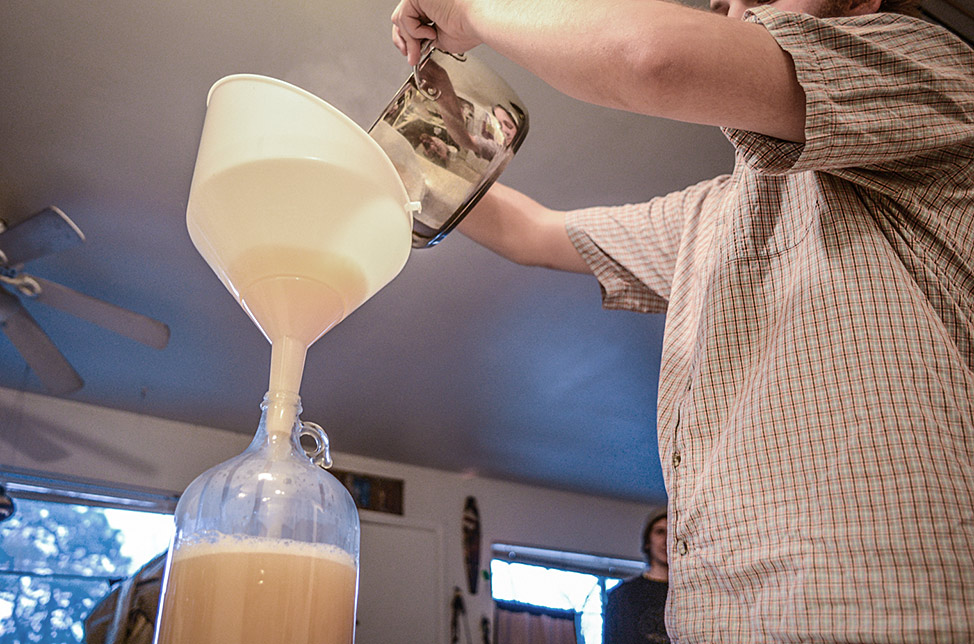
You probably already have a 2 to 4-gallon pot, funnel and maybe even a kitchen thermometer. That leaves a 1-gallon glass jug, airlock, bung and (mini) siphon. Throw in a 2-gallon primary bucket, grain bag and hydrometer, and you’ve got yourself a pico-homebrewery.

Bottling equipment is more or less the same as usual, but a 2-gallon plastic bucket can be rigged with a spigot for small batch bottling.


Mini-Recipes

Ingredients for a 1-gallon recipe can start around $10-$15 for simpler styles, with yeast comprising most of the cost. As the recipes include more ingredients, the price will increase, but rarely over $25-$30 for most styles.

It is up to the brewer to put together a 1-gallon recipe, as they are not widely available in recipe books or as kits. The ingredients in a favorite 5-gallon recipe can be divided by five for a rough approximation, or brewing software can be used for more precise scaling.

If developing your own recipe from scratch, conceptualize the grains as percentages. Percentages are easier to deal with when using such small amounts of individual ingredients, and scaling up a recipe to any size is a breeze.


Small Batch Brewing

Extract and partial mash brewers can go about business as usual, taking extra care not to let the extract scorch on the bottom of the pot. All-grain brewers have some options.

For the sake of simplicity (and cheapness), mash small batches using the brew in a bag technique. (www.brew-boss.com) The entire brew day process can be conducted in one 3 or 4-gallon pot—simply mash the grains in a large grain bag, remove the bag once complete and carry on with the boil. If small batch brewing is your calling, consider building a mini mash tun and sparging for higher efficiency.

The small volume of wort requires much less yeast than you may be used to. In fact, if you pitch an entire yeast pack into some 1-gallon recipes, you may actually be over-pitching, an issue not common to the typical homebrewer. It is worth the few dollars to purchase a small measuring cup that measures by the half ounce for liquid yeast. Use a kitchen scale for dry yeast.

When managing fermentation, you have some options as a pico-homebrewer. A mini-fridge could hold a carboy or two, or a small version of a son of a fermentation chamber can be fashioned to hold multiple fermenters. One of the cheapest and most effective ways is to submerge a 1-gallon carboy into a bucket of water with a cheap, small-volume aquarium heater. The aquarium heaters are temperature controlled, and a frozen water bottle can be used when warmth is an issue.

Share the Love

So what are you waiting for? Grab yourself a 1-gallon jug and start small batch brewing! Not only is this a great opportunity for all homebrewers to get experimental, it is an affordable gift to get your non-homebrew friends hooked on the obsession that is beer making.


https://www.homebrewersassociation.org/how-to-brew/a-big-idea-on-small-batch-brewing/

Sunday, November 8, 2015

What is SMaSH brewing?

www.brew-boss.com Brew Boss Electric Homebrew Systems

Beers are complex. They typically consist of several types of malt, some base, some specialty, and this lends to the complexity of the beer. In the same sense, many beers use more than one hop type, again adding to the complexity and dimension of the beer. Beer is the sum of all of its parts, but to create it you must understand each singular part.

SMaSH stands for single malt and single hop. The acronym was coined by a group of dedicated brewers at the popular home brewing forum HomeBrewTalk. A SMaSH brew is a way for any brewer to really get a feel (taste) for any base malt and any hop variety. It is also a very economical way to brew as it minimizes the cost of the batch.

SMaSH brewing is an excellent way to learn about the flavors various malts and hops impart on a beer. By focusing on just one grain and one type of hops in a recipe, you can truly get a feel for the flavor of the malt and hops used. This being said, unless you are experimenting with the properties of different yeasts, you will want to keep to a clean fermenting yeast like S-05, WLP001, Nottingham etc. Otherwise, the flavors contributed by the yeast will begin to overshadow those from the malt and hops.

A typical SMaSH recipe would resemble the following:

Malt:
8 lbs Maris Otter
Mash for 60 minutes at 153F

Hops:
1 oz Centennial @ 60 min.
.5oz Centennial @ 10 min.
1 oz Centennial Dry Hop

Yeast:
SafAle S-05

Though not complex, a SMaSH brew will not only showcase the properties of the single malt and single hop being used. It can and will create a clean and easy drinking beer that will remind you with each glass of the properties of these individual ingredients. When formulating recipes, you will know if Maris Otter will suit your recipe better than Rahr 2-row pale malt. You will also have a better idea of whether or not you would prefer Centennial or Cascade in a certain recipe as well.

In order to formulate a recipe and enjoy the sum of all the parts, you need to understand the properties of each individual part. Do some experimenting, use your hop of choice for bittering, flavor and aroma. Explore the ability of the hop to create a favorable outcome in each of these roles. You may enjoy the bitterness of Centennial, but not the flavor or the aroma…. so be sure to use it in each of these capacities in your SMaSH.

One variation on this method is to split the batch into several parts. Brew a SMaSH brew and then split the 5 gallon batch into (5) separate 1 gallon batches. Pitch a clean fermenting yeast into one batch (WLP001, Nottingham, S-05) and then use any other yeasts that you are interested in testing into the other fermentors.

At this point you will have a simple beer where the yeasts properties can shine through. The clean fermenting yeast will provide a control, a flavor profile that all of the other yeast varieties can be judged against. With one 5 gallon brew you will be able to experiment with (5) yeasts and explore the properties of the malt and hops chosen for the SMaSH.


http://www.brewersfriend.com/2009/09/05/what-is-smash-brewing/

Saturday, November 7, 2015

Learn to Homebrew Day 11/7/2015


Learn to Homebrew Day (LTHD) was established by the American Homebrewers Association (AHA) in 1999 to encourage homebrewers to introduce their non-brewer friends and family to the most rewarding hobby, obsession and lifestyle since the beginning of time!

Make your own beer today! www.brew-boss.com Electric Homebrew Equipment

Friday, November 6, 2015

5 Tips on Brewing IPAs from Mitch Steele

Brew Boss Electric Home Brew Equipment www.brew-boss.com


Judging by the trends the American Homebrewers Association has seen, the India pale ale still reigns supreme as a favorite style of both homebrewers and craft beer enthusiasts.

IPAs occupied the top five places in Zymurgy‘s Best Beers in America survey, with Russian River’s Pliny the Elder claiming the number one spot for the fifth consecutive year, and half of the top fifty were some form of the style.

Mitch’s Tips for a Great IPA

In celebration of IPA Day (#IPAday) we asked Stone Brewing Co. Brewmaster Mitch Steele to offer some tips on homebrewing great India pale ales.

Steele has been brewing at commercial facilities, large and small, for the last 25 years, and he has always had an obsession with hoppy IPAs (visit his blog, The Hop Tripper). This obsession culminated in Steele’s recent book IPA: Brewing Techniques, Recipes and the Evaluation of India Pale Ale.

In addition to forty-eight IPA recipes ranging from historical beers to popular commercial clones, Steele’s book covers everything you need to understand the celebrated style inside and out.

Here are five tips from Mitch Steele, which might help your IPA competition entries rise to the top…or at the very least you’ll end up with tasty IPA to share!
  1. Keep the crystal malts to a minimum (5% or less). Use Munich malt or some other lightly-roasted malt if you want more color.
  2. British pale ale malt (Golden Promise or Maris Otter) is excellent for using in all versions of IPA.
  3. Don’t forget about older “classic” hop varieties. Everyone wants to use Amarillo, Mosaic and Citra right now, and understandably so. These are exciting new varieties that provide unique flavors, but some of the best IPAs I’ve had recently were dry-hopped with Cascade or Sterling.
  4. Similarly, don’t be afraid to use hops that aren’t considered “IPA hops.” There are some great, highly aromatic hops available from Germany and England, for example, that add wonderful nuances to an IPA.
  5. Brew your beer to be reasonably dry. This means using lower mash temperatures (148-152°F) to make highly fermentable wort. This is especially important in double IPAs because higher alcohol adds a perception of body and sweetness to a beer, and you don’t need to add to that by having a lot of unfermentable dextrins. Drier beers allow the hops to shine.

Bombay Bomber IPA

The following is a recipe from IPA: Brewing Techniques, Recipes and the Evolution of IPA. This recipe is formatted so it can be used for a batch of any size. Grain percentages, original gravity and hop additions along with target IBUs should be enough information for homebrewers to deduce a recipe fit for their target batch volume and system.

When Steelhead Brewing Company opened on January 22, 1991, Bombay Bomber IPA was on draft as the seasonal offering. The IPA was such a hit that Steelhead never took it off tap, making Bombay Bomber one of the first IPAs to be continually served as a flagship offering at a U.S. brewpub.

Teri Fahrendorf, former Steelhead brewer, developed Bombay Bomber and describes it as a “party in your mouth.” More specifically, the brewpub menu stated: “Deep gold. Citrus-floral hop aroma with lots of malt flavors, leading to an intense hop finish.”

Ingredients
Western (American) two-row malt (71%)
American Munich malt 10°L (22%)
American Vienna malt 4°L (7%)
Chinook hops (90 minutes)
Crystal hops (20 minutes)
Chinook hops (0 minutes)
Crystal hops (0 minutes)
Chinook (dry)

Specifications
Original Gravity: 14.2 °P (1.057 SG)
Final Gravity: 3.2 °P (1.013 SG)
ADF: 77.5%
IBU: 57
ABV: 6%

Directions

The recipe traditionally uses Eugene, Oregon mountain run off (soft) water with added gypsum.

Employ a single-step conversion mash at 153°F (67°C) for 1 hour.

Follow the 90 minute boil schedule as noted in the ingredients. Fast chill and transfer to a fermenter in 10 minutes (this is what saves the aroma!).

Ferment at 67°F (19°C) for 18 days with the yeast of your choosing. On the third day, dry hop with Chinook at bunging. Beginning on day four, make sure to keep top pressure on the beer to naturally carbonate. Pull the yeast on day 10. Chill to 32°F (0°C) for the final three days (days 19-21), and filter for a bright, crisp taste.

https://www.homebrewersassociation.org/how-to-brew/5-tips-on-brewing-ipas-from-mitch-steele/

Wednesday, November 4, 2015

Do You Want Some Beer?

Make your favorite beer using the Brew Boss Electric Homebrewing System! 
Your Beer, Your Way!