Friday, August 14, 2015

Phenolics and Tannins in Home Brewed Beer


This week we explore the problem of phenolic (and tannin) flavors in beer. Phenolics are usually considered an off flavor, though in some beer styles they may be desirable at low levels. This week’s article is part of my ongoing series on off-flavors in beer including the previous articles on Diacetyl,DMS, and Esters as well as my article on judging beer.

What is a Phenolic?


Phenolics cause some confusion because they can introduce a variety of flavors to home brewed beer which vary from clove and banana at the low end to spicy or smoky flavors or even medicinal or band-aid like flavors in the extreme. In certain styles, notably German weizens and many Belgian beers the clove flavor can be desirable, but in most beers phenolics are considered a flaw.

Phenols or phenolics are chemical compounds similar in chemistry to alcohols (though not alcohol) that tend to be highly acidic. In fact some phenols are actually used as cleaning agents. They come in many varieties (polyphenols, chlorophenols, etc…), which is why they can drive several different off flavors in beer when present.

Phenolics are naturally produced by many yeast strains during the fermentation process, with some Belgian, German and British yeast strains being higher level producers. Another common source of phenols are wild yeast strains, which often contribute band-aid like flavors.

Sources of Phenolic Flavors in Beer


Because phenolics are produced by most yeast strains, they are present to some degree in any beer. However several key points in the brewing process and ingredient selection can drive how bad your phenolic problem will be in the finished beer.

Water Selection (Chlorine)

First, the use of chlorinated water for brewing is a bad choice. If you have water that is highly chlorinated, the chlorine will react with naturally occurring phenols in your beer and produce chlorophenols which have a very low taste threshold and are instantly picked up as a flaw when tasting. Chlorophenols manifest themselves in the finished beer with a strong band-aid or even diaper aroma and flavor.

Even if your regular tap water is relatively free from chlorine, you need to be aware that most US water sources are flushed about once a year with higher levels of chlorine to purge the system. If you happen to brew during that week, you may get a strong band-aid flavor. Using bottled RO water is a good alternative. Finally if you use chlorinated cleaning agents, such as bleach, you need to be thorough in rinsing your equipment before use as this can also introduce chlorine to the beer.

Mashing and Sparge Process

Another form of phenol is called polyphenols, which are more commonly called tannins. Tannins (polyphenols) tend to manifest themselves as an astringent or bitter flavor in the finished beer, and may also lead to a permanent haze or chill haze (haze that shows up when the beer is chilled).

Tannins can be extracted by oversparging (continuing to sparge too long when mashing), sparging at too high a temperature (greater than 170 F or 77 C), or mashing at too high a pH level. pH levels above 5.5 are particularly prone to tannin extraction, with 5.1 or 5.2 being an ideal pH level during the mash. Any of these can lead to cloudy beer, chill haze and an astringent or bitter flavor in the beer.

Yeast Selection

As mentioned in the introduction, all yeast produces phenolics to some degree, but some yeasts are more prone to phenol production. In particular wild yeasts and Belgian yeasts tend to produce high levels of phenols in the finished beer. At low levels this manifests itself as a clove like flavor that is desirable in many Belgian beers as well as the classic German hefeweizen. However, if too many phenols are present it may morph into a smoky or spicy flavor or even the dreaded band-aid flavor.

Altering your yeast may be a good choice if you have a phenolic batch. Also be careful not to introduce wild yeasts which tend to produce very high phenolic flavor concentrations.

Other Phenolic Sources


In addition to wild yeast, many other wild organisms produce phenols including algae and bacteria. So if your water source is of questionable quality or from a surface source such as muncipal streams and lakes you may want to consider using bottled RO water for brewing instead. Bacterial infection can also produce a strong phenolic flavor, often in combination with sour off flavors. This can often come from infection of hoses, valves and taps used in brewing or serving the beer.

Summary on Phenolics
Phenolics can be one of the toughest flaws to properly diagnose because, as noted above, they manifest themselves as several different flavors and also have a variety of possible root causes. The critical areas to focus on are water selection, proper pH balance during the mash, sparging at the appropriate temperature, good sanitation throughout and finally yeast selection.

http://beersmith.com/blog/2012/06/19/phenolics-and-tannins-in-home-brewed-beer/

Wednesday, August 12, 2015

Troubleshooting Homebrewed Beer

We examine the topic of troubleshooting homebrewed beer. Despite the best laid plans of mice and men, not every beer you brew is going to be a homerun. Homebrewing beer is a combination of both art and science, and sometimes the art or science goes wrong.
Fortunately all is not lost, for each bad batch is an opportunity to learn how to diagnose and improve your next batch. Assuming you’ve already taken the time to carefully design your beer and match the target style, the next thing to examine is the taste of your beer. Beer troubles each have their own unique signature which you can evaluate using the guide below.

Bitterness

Excess bitterness in your beer is usually perceived on the back of the tongue, and often manifests itself as a bitter aftertaste. If bitterness is too low the beer often will have a very malty, sweet or grainy profile. Some beers such as IPAs require high bitterness, while others such as Scotch and many German ales require a malty profile.
Excess bitterness is created by overuse of boiling/bitterness hops, long boil times, the use of black or roasted malts, and the use of alkaline water or water with excess sulfates. Conversely low bitterness can result from a low bitterness to gravity ratio, too little hops, malty grains such as Vienna and Munich malts, short boil time or high fermentation temperatures. Filtration can also reduce the bitterness of your beer in many cases.

Body

Body is often referred to as mouth-feel or the thickness of the beer. Full bodied beers have a well rounded thick feel to them while light bodied beers have a thin profile.
I recently wrote a complete article on how to enhance the body of your beer. Some techniques include adding caramel, crystal or carafoam malts, lactose, malto-dextrin, adding more malt overall, adding wheat, increasing the mash temperature of your beer and fermenting at a lower temperature. Conversely thin beers can be created by reducing additives, adding rice or sugar, decreasing mash temperature and fermenting at higher temperatures.

Diaceytl Flavors

Diaceytl flavor comes through as a buttery or butterscotch flavor. It is most often caused by incomplete fermentation. Potential causes include an old or undersized yeast starter, lack of oxygen in the wort before fermentation, lack of yeast nutrients, bacterial contamination or use of excessive adjuncts such as corn or rice that lack proper nutrients. Finally, if you prematurely halt fermentation by suddenly raising or lowering temperature, adding finings too soon or choosing a yeast with very high flocculation you can get a distinct butterscotch flavor in your beer.
You can counteract diceytl by starting with an appropriately sized yeast starter, making sure your wort is properly oxygenated before fermentation, avoiding contamination and making sure a majority of your grain bill contains fresh barley malt. Barley malt naturally has the nutrients needed for proper yeast growth.

Alcoholic Profile

The alcoholic profile of a beer is most often perceived as a warm sensation in the mouth and throat. Different styles obviously require different alcohol profiles as indicated by the starting and ending gravities in the BJCP Style Guide. Ideally a beer should have a balanced profile that compliments the overall flavor.
Fusel alcohols leave a solvent like flavor in the beer and are most often produced by fermentation at excessively high temperatures. Fermenting in the recommended range for your yeast can mitigate any solvent-like fusel flavors.
Overall alcohol balance can be controlled by adjusting your original gravity to match the style of beer as well as taking proper care in fermentation to make sure the wort is properly aerated, pitched and kept within the recommended temperature range during fermentation. If there is a significant mismatch between the alcohol content and body of the beer, you can also look at adjusting the body of the beer (described above) to better balance your recipe.

Astringency

An astringent flavor comes across as grainy or a raw husky flavor. In some cases it may be dry or similar to the flavor of grape skins.
Astringency is most often caused by oversparging your grains or boiling your grains. It can also be caused by sparging with excessively hot water (over 175F), excess trub in the wort, and overmilling of your grains. You can minimize astringency by proper milling, sparging and a good rolling boil when brewing your beer.

Phenolic Flavors

Phenolic flavors are perceived as a medicinal or band-aid like flavor that can be quite harsh. It also sometimes is perceived as plastic, smokey or clovelike. Strong phenolic flavors can make the beer harsh or even undrinkable in some cases.
Phenolic flavors, like astringency, can be caused by oversparging or boiling your grains. In addition the use of chlorinated tap water or presence of bacterial contamination can also cause phenolic flavors. Excessive use of wheat malts or roasted barley malts can also lead to clovelike flavors. Check your equipment and bottle caps for leaks and potential contamination, carefully control your sparging process and use an alternate water source if needed to mitigate phenolics.

Dimethyl Sulfide (DMS)

DMS flavors and aromas come across as cabbage, rotten eggs or a sweet cornlike aroma. Excess DMS can spoil your beer.
DMS has many potential causes. These include high moisture malt (especially 6 row), bacterial contamination, oversparging at low temperature (below 160F), and underpitching your yeast. Covering your pot during the boil can also create DMS. Storing malt in a cool dry place, care when sparging and boiling, and a proper yeast starter can help to mitigate the ill effects of DMS.

Sour/Acidic Flavors

Sour and acidic flavors may be perceived as a bitter, cider-like, lemon-juice or sour candy flavors usually at the side of the tongue.
One primary cause of sourness is contamination due to inattention to proper sanitation. The use of excessive sugar, particularly refined sugars used by many beginners can also introduce a sour cider-like flavor. Other causes include the addition of excessive ascorbic acid, introduction of bacteria or contamination, excessively high fermentation temperatures and storage of the beer at very warm temperatures.
http://beersmith.com/blog/2008/09/21/troubleshooting-homebrewed-beer/

Saturday, August 8, 2015

Cold Steeping: Getting the Most Out of Dark Grains

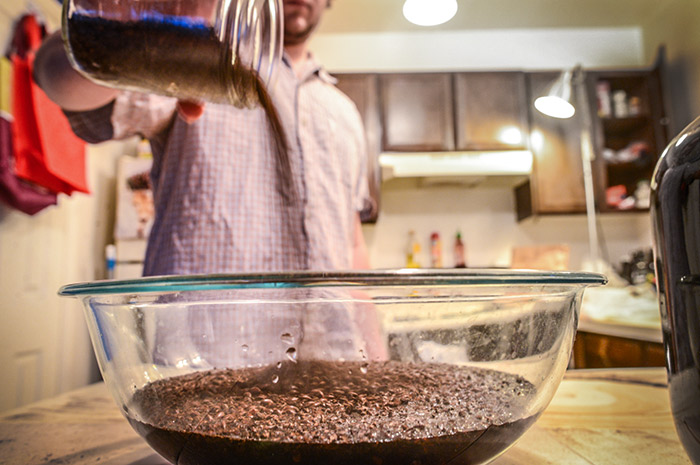
      Cold Steeping

Brewing with dark specialty grains is essential to develop roasty flavors and aromas and achieve various colors, but working with dark grains can also result in unfavorable harsh flavors. Sometimes confused with hop bitterness, the burnt and acrid components derived from mashing dark grains usually occur due to prolonged periods of contact with hot water.

Mashing Dark Grains

It is common practice to throw all the grains for a recipe into the mash. This is usually fine, but dark grains like black malt or roasted barley do not need to undergo conversion for brewing—this is why extract brewers can use specialty grains.

Get Experimental

Not every grain reacts the same while being processed for brewing. Two grains of the same color may not necessarily benefit from a cold or hot steep. Start by taking a day to experiment with the grains you will be dealing with. Try soaking the grain in question in room temperature water and at steep temperatures for 5 and 60 minutes. You may be surprised by what you prefer!
 
During the kilning process maltsters conduct to produce darker grains, high temperatures break down almost all of the proteins and starches in the grain, leaving little to nothing to be converted in a mash. So when adding dark grains to a mash, you are essentially conducting a long, high-temperature steep and not any sort of conversion.

Dark grains do help optimize the pH of the mash because of their high acidity, but troublesome mash pH can be altered by other means if needed.

The Fuss About Husks

Most malted grains come with husks still intact, though a small variety of huskless grains are available. When the husks of dark-roasted grains are included for an entire mash duration, or even just the sparge, the prolonged period of contact with hot water allows for the tannins in the husks to be extracted. In beer, tannins translate to astringency.

If you want to get a bit more technical, the unfavorable, harsh components are derived in the mash when complex melanoidins are extracted. The favorable melanoidoins are structurally much simpler and do not necessitate a prolonged hot steep to extract.

Cold Steeping

Cold Steeping

Cold steeping is a process popularized by Mary Anne Gruber at Briess. The idea was to find a way to extract the favorable flavors from dark specialty grains, but leave behind the harsh characteristics, giving the brewer a greater level of control over the color of the beer.

Gruber found that for some dark grains (see side bar), steeping the crushed grains in room temperature water for 24-hours creates an extract that can be added to the boil pot or fermenter. Flavor aside, Gruber noted that the less heat involved in the process, the richer the aromas.

Homebrewers can create a cold-steeped extract by soaking 1-pound of crushed grains in 2-quarts of water overnight. After 24 hours, strain the grains and add to the beer as your preference dictates.
If you intend to add the extract to the boil pot, pour it in within the last 5-10 minutes of the boil. If you add it earlier, the length of the boil can bring out some of the harsh attributes. If adding to the fermenter, take care to avoid oxygenating the wort.

The remaining extract can be heated to 150°F, transferred to a mason jar and refrigerated for up to a month for use in future brews.

http://www.homebrewersassociation.org/how-to-brew/cold-steeping-getting-the-most-out-of-dark-grains/

Thursday, August 6, 2015

5 Benefits of Brew in a Bag (BIAB)

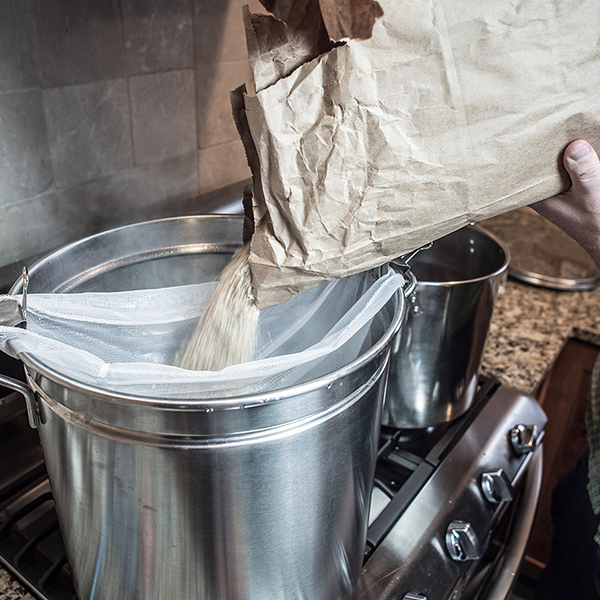
5 Benefits of BIAB

Brew in a bag (BIAB) continues to grow in popularity as a cheaper and simplified way to pursue all-grain brewing. Here are five benefits of BIAB when moving to the mash.

1. Minimal Investment

Jumping into all-grain brewing can be daunting, not only because of the additional procedures that must be grasped, but the perceived cost of acquiring a mash tun and sparge pot. Sure, a mash tun can easily be built for a relatively low price, but it still isn’t as cheap as simply buying a large grain bag.
Full-boil extract and partial mash brewers only need to buy a grain bag large enough for their recipes. Newbies looking to jump straight to all-grain just need a large boil pot and grain bag, which is more or less the same as when pursuing full-boil extract with specialty grain batches.

2. Simplified Procedures

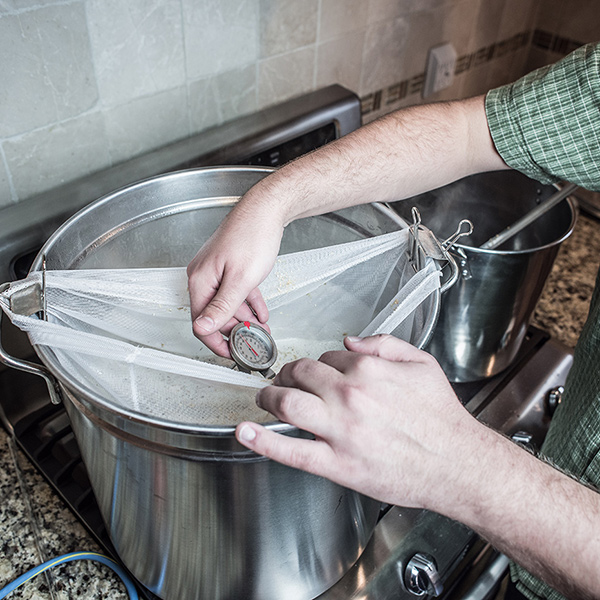
5 Benefits of BIAB 2
While you must pay careful attention to mash rest temperatures and duration, the all-grain process is actually simplified when doing BIAB.
Traditional steps like the vorlauf, latuering and sparging are basically skipped, though the same results achieved as if mashing and lautering in a tun.
With no-sparge BIAB, simply mash in enough water to leave you with your desired pre-boil gravity, remove the grains and let them drip dry, and carry on with the boil as usual.

3. Small Footprint

All-grain brewing with traditional mashing equipment can make for a cramped brew day, especially if you are strictly an indoor brewer. When doing no-sparge BIAB, all you have is one pot. That’s it—no mash tun or pots in addition to the boil kettle. Heck, you could probably get two mashes going with all of that extra space!
And when you’re done, throw the cleaned and dried grain bag into your boil kettle and stick it in storage. This takes  up considerably less space than a mash tun and multiple pots. If you are an apartment brewer, you will appreciate how much space this actually saves.

4. Quick Cleanup

5 Benefits of BIAB

Let’s face it, as homebrewers, we spend quite a bit of time cleaning and sanitizing (and cleaning some more).
When brewing all-grain with BIAB, less equipment means less things to clean at the end of the brew day.
On top of that, simply pull the bag of grains out, dump them on your compost pile, and give the bag a rinse to clean your “mash tun.”
If you’re feeling particularly unmotivated, throw your grain bag in with your next load of laundry (but avoid the scented detergents)!

5. Highly Adaptable

While the previous points all assume a single-vessel, no-sparge brew in a bag process, BIAB is actually highly adaptable depending on one’s goals as a homebrewer. If you shutter at the idea of no-sparge, mash in with the standard 1-2 quarts of strike water per pound of grain and account for the rest of the pre-boil gravity with sparge water!
This sparge step can also be particularly beneficial to those who want to do BIAB but don’t have a pot large enough to fit no-sparge volumes. BIAB also lends itself to step mashes since it takes place in a vessel that can withstand direct heating, as well as allowing for a high degree in flexibility with final batch volumes.

Looking for an Electric BIAB give Brew Boss a try.  www.brew-boss.com

http://www.homebrewersassociation.org/how-to-brew/5-benefits-of-brew-in-a-bag-biab/
 

Tuesday, August 4, 2015

THE DELIGHT OF HIGH-GRAVITY BEER

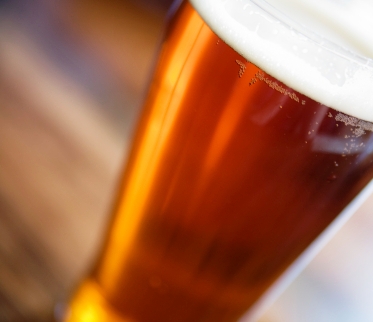
high gravity beer
If your motto is “Go big or go home,” you will probably love the big flavor and strong alcohol content of high-gravity beers. Just remember that they pack a punch, so take your time and sip leisurely!

What is a High-Gravity Beer?

“Gravity” refers to the amount of fermentable sugars present during the beer brewing process. Higher sugar content means more food for the yeast to consume and turn into alcohol.

Brewers take the gravity reading of the unfermented ingredients before adding yeast to them. That original gravity has a number like 1.061 or 1.080, and the higher the gravity, the higher the potential alcohol content of the beer.

Throughout the beer brewing process, brewers keep checking the gravity to make sure it stays consistent. After fermentation is complete, they measure the final gravity of the beer and compare it to the original. The difference between the two numbers shows how much sugar was converted into alcohol.

What’s the Appeal of High-Gravity Beer?

High-gravity beer is not for the faint of heart – it does, after all, have a high percentage of alcohol. But high-gravity brews are perfect for craft beer enthusiasts who love to explore bold flavors and creative combinations. Strong ales, barley wines, imperial porters and imperial stouts are just a few examples that offer a range of bitterness, sweetness, maltiness and fruitiness.

Dogfish Head High-Gravity Beers to Try

120 Minute IPA
Called “the Holy Grail for hopheads,” this beer has 15-20% alcohol by volume (ABV) and balanced flavors of citrus, spice and caramel malt. The 120 Minute IPA goes well with smoked or grilled meats.

World Wide Stout
This dark, complex stout only gets better with age. It has 15-20% ABV and has hints of chocolate molasses, pairing well with dessert.

Sunday, August 2, 2015

WHY IS BEER SCIENCE IMPORTANT?


Why does Beer Science MATTER? How is it RELEVANT to people’s lives?


Set Industry Standards for a new and growing community.

Believe it or not, but beer isn’t very regulated. The laws surrounding distribution and labeling are pretty strict, but not so much for the actual product. In fact, tobacco products are required to pass five separate analyses of the final product before it can be sold. Beer only requires one(ABV). They are even regulated by the same government agency (TTB). Our industry needs to step up – Craft Beer should be synonymous with Quality Beer.


Weed out sub par beer and brewery practices

I’m not one to bash breweries – I think every brew has at least one good characteristic. And if the flaws outweigh those characteristics, then the brewery simply needs to be introduced to a bucket of strong sani and some consistent Beer Analysis. It’s no secret that a handful of Oregon breweries close their doors or change their names after getting a reputation for treating employees poorly, selling bad beer, and/or not selling enough beer – an indication that it’s not very good or not very original. Wouldn’t it be great if you never had to send another pint back?


Further our understanding of the fermentation process and applications

Beer research is only recently taking off with efforts like the Siebel Institute and Oregon State University Fermentation Science. It’s because of these important research hubs that we have so many great and educated brewers. The more we can get the better our collective beer is going to be.


Know the Ingredients in what you Consume.

Alcohol is a central nervous system depressant. This is well known and documented. And yet, while people are trying to change government policy for GMO labeling, no one is trying to get government policy on accurate ABV (alcohol by volume) measurements. Why be politically active for a method of food growth (in which no health issues or links have been scientifically proven), but not for an actual drug you are ingesting?


Accurate beer analysis is the difference between a DUI and a safe drive home.

I’ve tested beer that has been more than 1% off from its labeled ABV. A beer labeled at 4.5% is a brew someone might have 2 pints of and still safely drive. That is NOT the case for a beer that is actually 5.5%. Now, I’ve been using this fairly extreme example for some time now – but just you wait – a lawsuit will happen one day where a driver was drunker than intended because of poor beer analysis. Let’s just hope no one gets injured.


Give confidence to beer consumers

Once drinkers are knowledgeable in the process of brewing and in the final product they will be able to easily navigate entire coolers of six-packs and bombers. Picking a random beer will no longer be hard. High quality beer + educated consumer = match made in heaven.


Encourage homebrewing!

Knowing beer science and understanding the process will make you a better brewer! (Use Brew Boss to help you brew www.brew-boss.com) And once people get a taste of how fun brewing is – changing different variables, temperatures, amounts, types of hops – they won’t stop! Beer is cool. Science is cool. Beer Science is the best.