#homebrewrecipe #brewbossbrewing Brew Boss Electric Brewing Equipment
www.brew-boss.com Since the Pilgrims landed on Plymouth Rock, brewing beer has been an integral component of American culture. In fact, Plymouth Rock was the “chosen” location simply because there was no beer left on the ships to appease the weary travelers. Everyday life without beer was out of the question, and brew houses were quickly built to quench the thirst of a future nation.
Fast forward a decade to the mid-late 18th century when one of America’s most notable forefathers, Benjamin Franklin, was in the height of his influential career. Remembered for his role in drafting the Declaration of Independence and dedication to the abolition movement, amongst countless other achievements, Franklin was also known to quaff the finest colonial ales.
Colonial Ales
The beers brewed by America’s forefathers were conceived and created similarly to those made by homebrewers and commercial brewers today. Recipes and styles were largely influenced by available local ingredients, ingredient prices and of course by the tastes of those swilling the ales.
During Franklin’s era some malt and hops were grown domestically, though the yield and quality of harvests were unreliable at best. Because of this, malt and hops were still imported from Europe, making the ingredients very expensive and causing brewers to think beyond the traditional beer recipes of Europe.
Local adjuncts were utilized for more fermentable sugars to supplement the less-than-desirable American malt and the expensive imported grains. Molasses, a very popular sweetener in colonial times, and corn were both common sources of sugar in beer making. Additional local ingredients such as pumpkin, spruce and imported spices were utilized to create more complex, flavorful beers.
But What Did Ben Drink?
Based on brewing and agricultural trends from the 18th century, along with some careful speculation, Tony Simmons of Pagosa Brewing Co. (Pagosa Springs, Colo.) developed a recipe deemed the most likely to be the choice ale of Franklin by a panel of experts at the 2005 Great American Beer Festival(R).
Simmons notes that Franklin was said to enjoy “strong, harvest-time ale,” but not so strong that he couldn’t carry on an intellectual conversation after having a few pints. Furthermore, popular styles of the time, such as porter and lager, were discounted because they were not prevalent in the colonies at this point. Based on this assessment, Simmons deduced Franklin’s style of choice to be similar to a medium-strength old ale of today, but it doesn’t end there.
Old ale is typically balanced towards malty-sweet, but there can also be prominent hop characteristics. In Franklin’s time, this was likely not the case. “I believe due to high cost of imported hops and the documented hop shortages in Colonial America, the hopping rates would have been appreciably less than that of old ale and more comparable to a strong Scotch ale,” said Simmons.

Poor Richard’s Ale Recipe
Tony Simmons’ colonial recipe, Poor Richard’s Ale, was brewed by 100 breweries across 35 states to celebrate Franklin’s 300th birthday on January 17, 2006. Poor Richard’s Ale was also the 2006 Big Brew recipe, with more than 3,000 homebrewers participating in making a batch of the colonial ale.
Simmons offers this description of the original recipe:
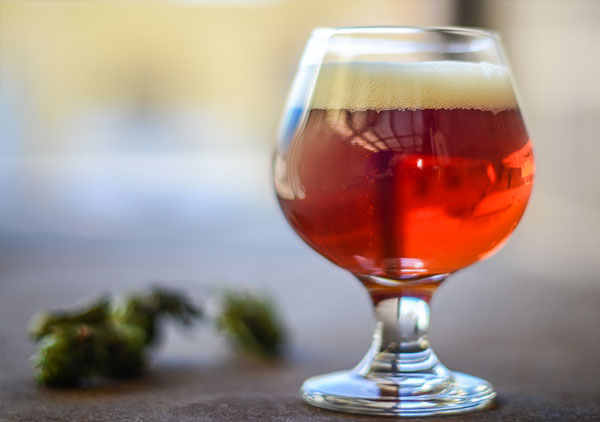
“Poor Richard’s Ale has a complex aroma with a pleasant malty, corny, and slightly nutty character, enhanced by a slight molasses-spiced undertone that adds an almost fine tobacco-like quality. The flaked corn will lighten the body and provide a nice counterbalance to malt flavors. Hop bitterness and flavor are designed to be medium-low. The molasses will add an additional level of spiciness/bitterness that will compensate for the lower IBU level (providing an impression of more bitterness than a typical Strong Scotch Ale.)”
All-Grain Ingredients for 5 U.S. gallons
6.75 lb | Maris Otter
2.75 lb | Flaked Corn
1.75 lb | Biscuit
1.0 lb | Special Roast
2.0 oz | Black Patent
4.0 oz | Dark Molasses
0.5 oz | Kent Golding, 5% AA (60 minutes)
0.75 oz | Kent Golding, 5% AA (45 minutes)
0.5 oz | Kent Golding, 5% AA (30 minutes)
Yeast | English (WLP002 or WY1968) or Scottish (WLP028 or WY1728)
Directions
Mash at 154°F for 45 minutes or until complete conversion. Boil 90 minutes, following the hop additions as noted. Add the dark molasses at 15 minutes to the end of the boil. Cool the wort to 68°F and transfer to a fermenter. Take a gravity reading and then pitch the yeast and aerate well. Carbonate to a level similar to an old ale or strong Scotch ale (1.9 – 2.2 volumes of CO2).
Brewing Up a Revolution
In 2013, the AHA staff gathered to whip up an extract version of the recipe to serve at Club Night during the National Homebrewers Conference in Franklin’s old stomping ground, Philadelphia!
Because the recipe includes Biscuit malt, which the team wanted to include, the recipe requires a mini-mash of sorts. The grains, less the Maris Otter and flaked corn, were steeped in 154°F water for 45 minutes and sparged with 170°F water. Five and a half pounds of light liquid malt extract were substituted for the entire Maris Otter portion of the grist, one and a half pounds of corn sugar substituted for the flaked corn, and Safale S-04 substituted for the recommended yeast—all ingredients that were on hand. For the extract and all-grain recipes used in Big Brew 2006, visit the AHA’sHomebrewopedia!
The final gravity weighed in at 1.064, a bit lower than the intended 1.068, likely due to the lax “mini-mash,” but Tony Simmons notes that an original gravity in the range of 1.060 and 1.086 will produce a colonial ale akin to what Franklin may have enjoyed. The sample tasted very sweet, with prominent molasses characteristics. Some noted a burnt marshmallow characteristic. Let’s hope we did old Ben some justice!